Let’s talk
The Intent Layer Sources
Chapters
Download PDF

Part II of VII3 min read

What the body already broadcasts

Intent leaves physical traces all the way from cortex to air. The question is which trace you can catch, and where you have to stand to catch it.

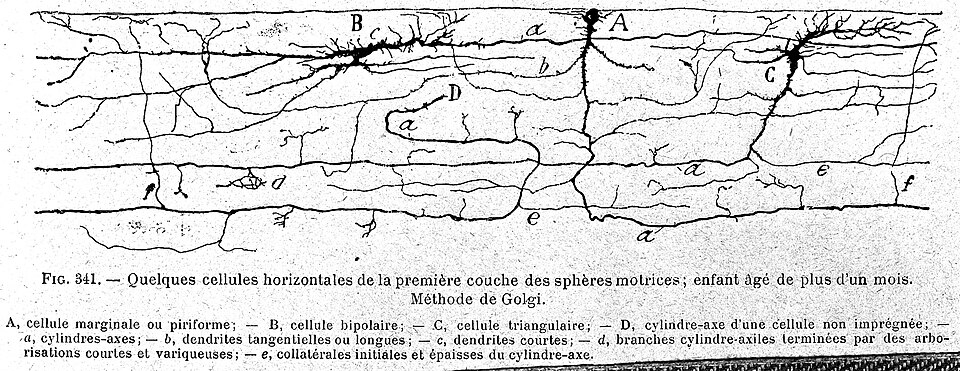
A historical ink drawing of nerve cells arranged in the layers of the cerebral cortex.
The cerebral cortex, drawn cell by cell from a stained section. Every method in this part listens, from a different distance, to tissue like this. Image: Wellcome Collection, CC BY 4.0.

When you decide to say a word, neurons in the cortex change their firing. Currents flow. Seconds later, blood supply shifts to feed the active tissue. Commands descend to the muscles of the tongue, jaw and larynx. Tissue moves. Air vibrates. Each stage is a place where an instrument can listen.

A BCI measures brain activity and translates it into commands for a device, giving the brain an output that does not depend on muscle.4 The term was coined in 1973.5 This is an old science with new tools.

Three rules make any result in this field easier to read. Reading is not writing: recording the brain and putting information into it are different problems, and this essay is about reading. Movement is easier than meaning: the strongest results decode attempted handwriting and speech. And the verb matters: seeing, hearing, attempting and imagining are different brain states, so always ask what the participant was doing.

Nine ways to listen

A scalp electrode stands to a neuron roughly as a weather satellite stands to a raindrop. It cannot see the single event. It sees the organised behaviour of millions, blurred by the skull. An implanted electrode is a rain gauge: exact, local, and somebody has to go through bone to install it.

Satellites changed the world and rain gauges did not, for one reason. Satellites cover everyone. EEG, the recording of electrical activity at the scalp, is the satellite of this field. It is a century old, safe, light and cheap enough to build anywhere. That is why it is the instrument this essay keeps returning to.

Figure 03Interactive

Where each instrument listens

Seven methods record the brain from different depths; two record the periphery and never touch neural tissue. Select a number to see what each does and does not measure.

  • Brain signal, no surgery
  • Brain signal, implanted
  • Peripheral signal, not a brain recording
Side view of a head showing nine sensing locations Scalp EEG and fNIRS sit on the skin. MEG sensors sit just off the scalp. An fMRI scanner surrounds the whole head. ECoG lies on the brain surface, intracortical arrays penetrate it, and an endovascular electrode sits inside a blood vessel. Surface EMG pads sit on the jaw and neck, and a radar sensor points at the face from a distance; these last two do not record the brain. 1 2 3 4 5 6 7 8 9
1 · Scalp EEG Brain · no surgery
Measures
Voltage at the scalp from large populations of cortical neurons firing in step. Millisecond timing.
Does not
Resolve small or deep sources. Skull and tissue smear the signal; muscle and eye movement easily swamp it.
Practical
Cheap, portable, decades of clinical use. Dry electrodes trade convenience for signal quality. Hair, sweat and motion matter.
Schematic, not anatomical scale. Sensor positions are illustrative. The dotted outline around the head stands for an fMRI scanner bore; the dashed arc for an MEG sensor helmet. Descriptions summarise standard measurement physics; study citations are in Figure 4.
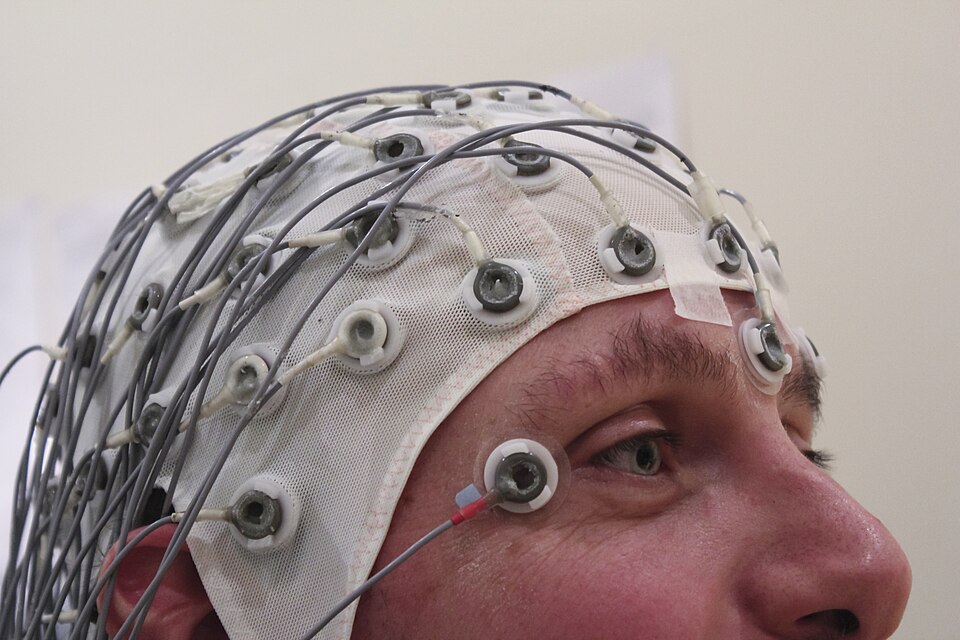
A person wearing a fabric cap studded with EEG electrodes.EEG · scalp electrodes
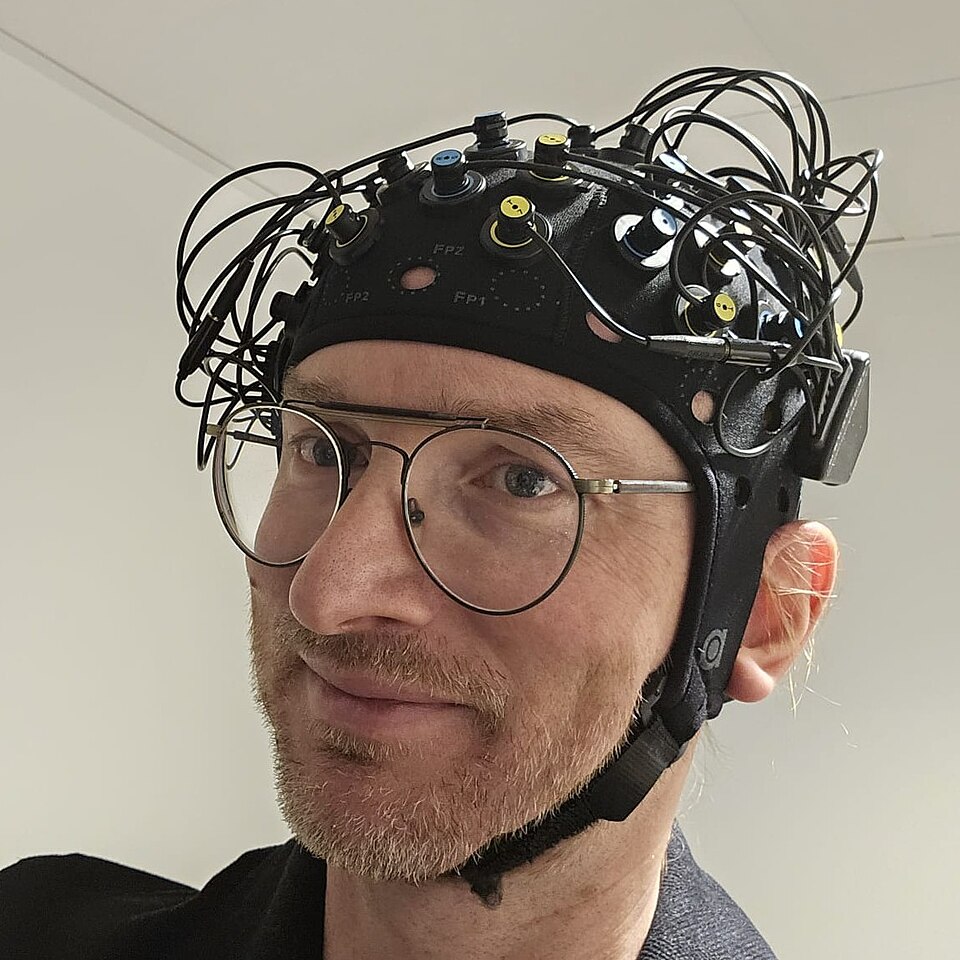
A person wearing a head cap fitted with optical fNIRS sensors and cables.fNIRS · light through the scalp
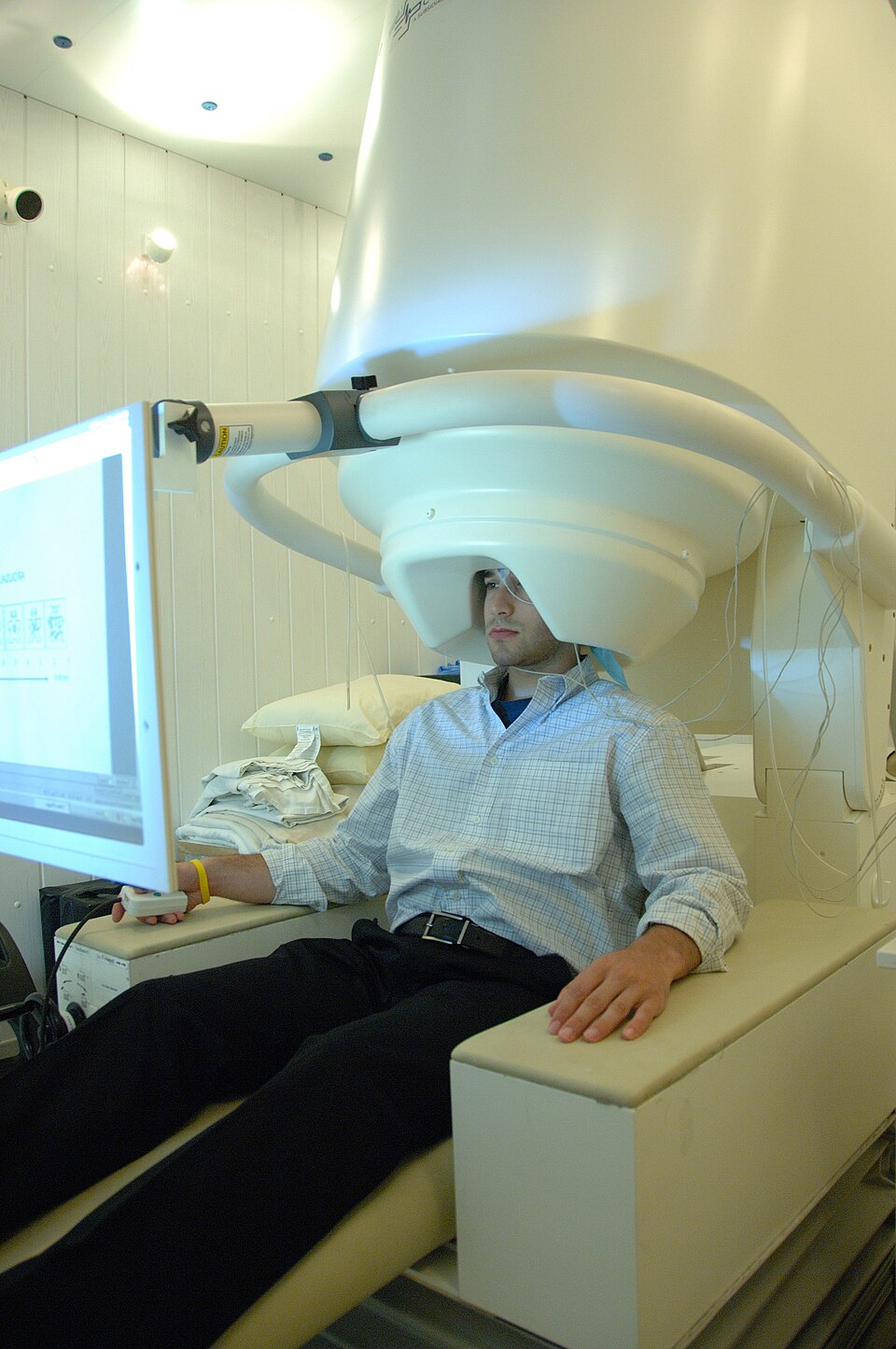
A magnetoencephalography scanner: a seat beneath a large white helmet-shaped sensor housing.MEG · inside a shielded room
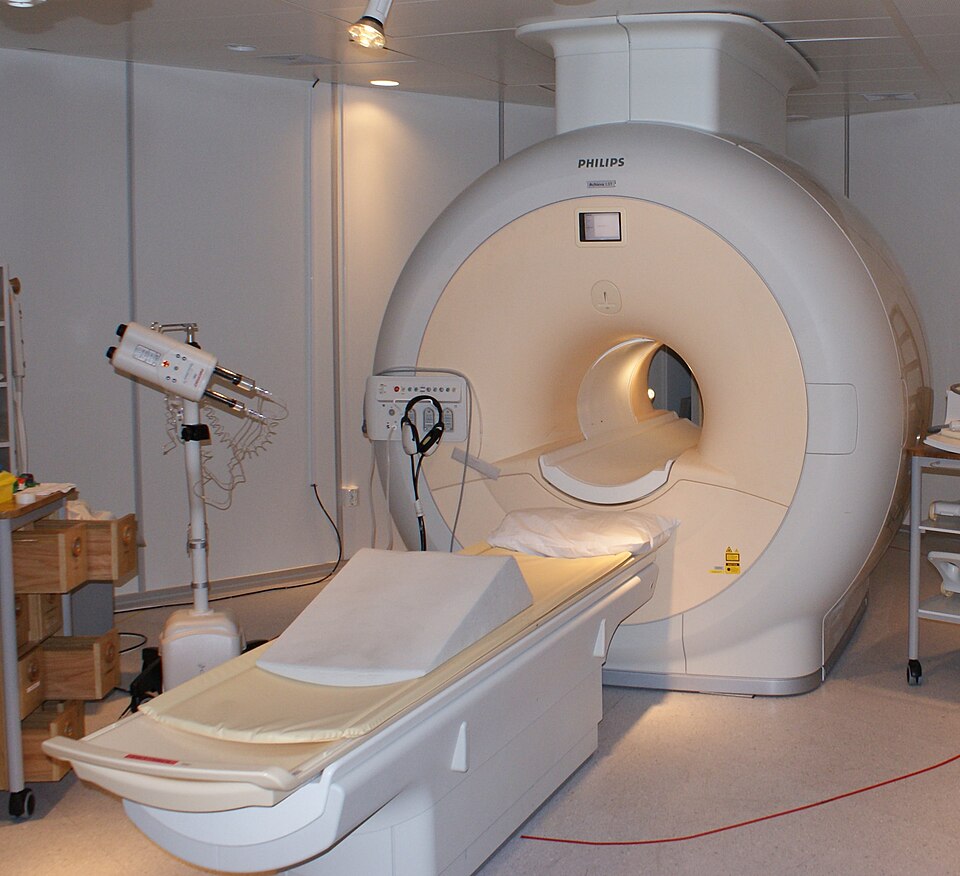
A hospital MRI scanner with its patient table extended.MRI · the scanner fMRI uses
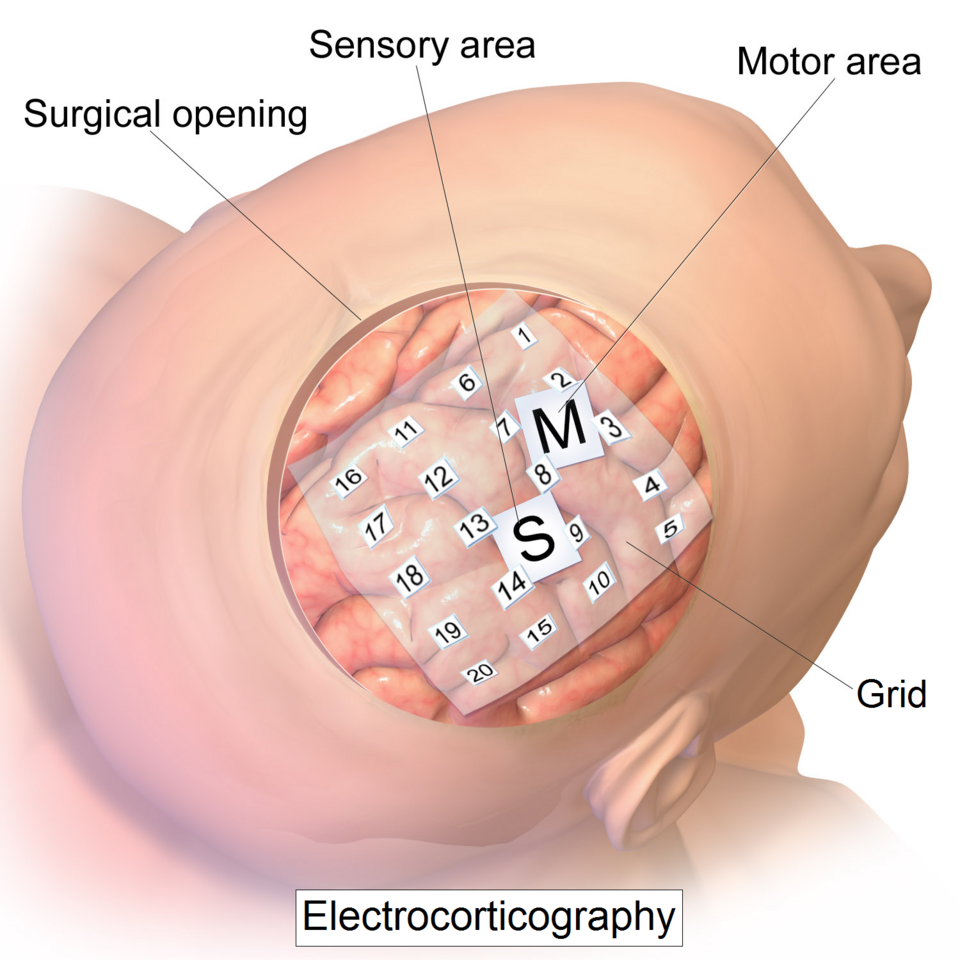
Medical illustration of an electrode grid placed on the exposed surface of the brain.ECoG · grid on the cortex (illustration)
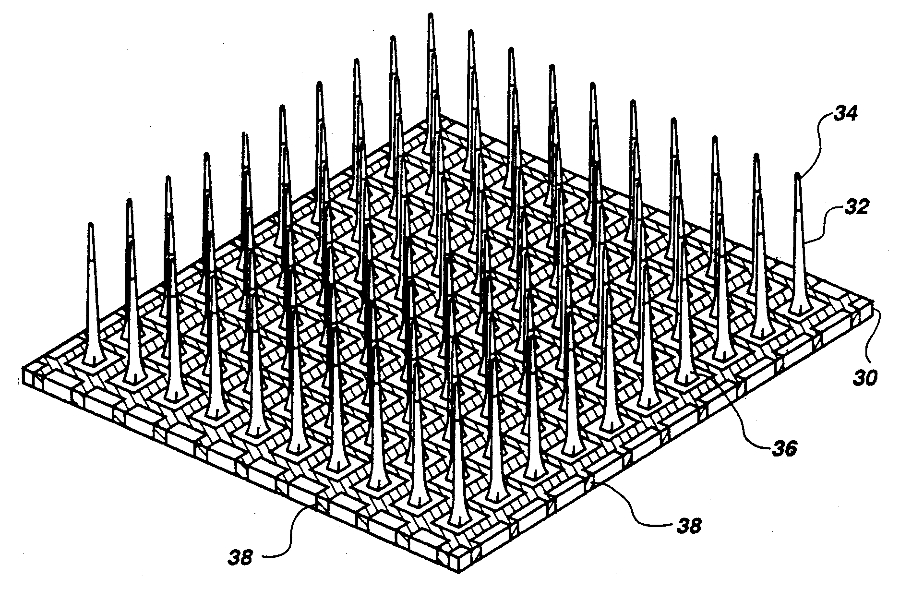
Patent drawing of a square array of one hundred needle-like electrodes.Intracortical array · patent drawing
The instruments themselves. The first four involve no surgery; the last two are implanted. Images via Wikimedia Commons: Chris Hope, CC BY 2.0; Alexarje, CC BY 4.0; National Institute of Mental Health, public domain; Jan Ainali, CC BY 3.0; Blausen Medical (BruceBlaus), CC BY 3.0; Richard A. Normann, patent drawing, public domain.

The evidence, verb by verb

Attempting to write. In 2021 a man paralysed from the neck down imagined writing letters by hand while implanted arrays recorded his motor cortex. The system produced 90 characters a minute at 94.1% accuracy.6

Attempting to speak. In 2023, two implant studies decoded attempted speech at 78 and 62 words a minute, with about one word in four wrong.78 A year later a third held 97.5% accuracy across eight months of daily conversation.9

Attempting to move. People with paralysis have steered robotic arms,20 felt touch written back into the brain,21 and walked again through a bridge between cortex and spinal cord.23 EEG alone has driven a robotic arm in continuous tracking.22

Perceiving. From inside a scanner, models have recovered the gist of a story a person was hearing,11 rebuilt pictures they were looking at,12 and adapted to a new person with one hour of data.13 With EEG and MEG, models can pick out which stretch of speech a listener was hearing.17 These pair a recording with a generative model. The signal supplies the meaning; the model paints the detail.

Typing. With no surgery, sentences have been decoded from magnetic recordings of people typing, at 39% word error.16 The same task on EEG is harder today: two characters in three were wrong.15 We read that as the starting line. Every curve in Part IV says EEG has the most to gain from data.

Mouthing. Away from the brain, silently mouthed words have been turned into speech from facial muscle signals,18 and a wrist sensor trained on thousands of people now works on strangers with no calibration.19

Thinking in words. In 2025, imagined sentences were decoded from four implanted participants. The same study showed how to stop a device decoding inner speech the user had not offered.25

Figure 04Evidence

The evidence wall

Sixteen studies, each stated the same way: what was measured, what the person was doing, what came out, and what the result does not show.

2012 · NaturePeer-reviewed
A robotic arm, steered from motor cortex

Signal: intracortical array · Verb: attempting to reach

3-D reach and graspTwo people with long-standing tetraplegia; one drank from a bottle unaided.

Did not show: speed or accuracy near able-bodied movement; use outside supervised sessions.

Details and source
Tested
2 participants, 96-channel array
Source
Hochberg et al.20
2021 · NaturePeer-reviewed
Handwriting without a hand

Signal: intracortical arrays · Verb: attempting to write

90 characters / min94.1% raw accuracy online; >99% offline with autocorrect.

Did not show: 90 words per minute; more than one participant; multi-year stability.

Details and source
Tested
1 participant with spinal-cord injury
Source
Willett et al.6
2021 · SciencePeer-reviewed
Touch, written back to the brain

Signal: intracortical recording + stimulation · Verb: attempting to grasp

20.9 s → 10.2 sMedian task time with a robotic arm, without and with evoked tactile sensation.

Did not show: rich or naturalistic sensation; writing of language or concepts.

Details and source
Tested
1 participant with tetraplegia
Source
Flesher et al.21
2023 · NaturePeer-reviewed
Speech, voice and a face from the cortical surface

Signal: ECoG grid · Verb: attempting to speak

Median 78 words / minMedian 25% word error rate; text, synthetic voice and avatar.

Did not show: error rates low enough for unassisted daily use; decoding of unattempted thought.

Details and source
Tested
1 clinical-trial participant with severe paralysis
Source
Metzger et al.7
2023 · NaturePeer-reviewed
Large-vocabulary speech from single neurons

Signal: intracortical arrays · Verb: attempting to speak

62 words / min23.8% word error on a 125,000-word vocabulary; 9.1% on 50 words.

Did not show: conversational accuracy (see 2024); results beyond one participant.

Details and source
Tested
1 participant with ALS
Source
Willett et al.8
2024 · NEJMPeer-reviewed
A speech prosthesis used for months

Signal: intracortical arrays · Verb: attempting to speak

97.5% word accuracySustained over 8.4 months; ~32 words / min; 248+ hours of self-paced use; 30-minute first calibration.

Did not show: generalisation across patients; performance without ongoing recalibration.

Details and source
Tested
1 participant with ALS, 256 electrodes
Source
Card et al.9
2025 · CellPeer-reviewed
Inner speech, and a lock for it

Signal: intracortical arrays · Verb: imagining speech

Imagined sentences, real timeInner speech is represented in motor cortex; some unprompted inner speech was decodable; safeguards blocked it.

Did not show: decoding of arbitrary private thought; anything outside implanted motor cortex.

Details and source
Tested
4 implanted participants
Source
Kunz et al.25
2023 · Nat. Neurosci.Peer-reviewed
The gist of a story, from blood flow

Signal: fMRI · Verb: listening (also imagining, watching)

Meaning, not wordsGenerated word sequences that recover the sense of heard speech.

Did not show: word-for-word transcripts; decoding without the person’s cooperation, which was required to train and to apply the decoder.

Details and source
Tested
3 participants, ~16 hours of scanning each
Source
Tang et al.11
2023 · NeurIPSPeer-reviewed
Rebuilding a viewed image (MindEye)

Signal: 7-tesla fMRI · Verb: looking at pictures

Retrieval and reconstructionIdentifies the viewed image among similar candidates; generates a resembling image with a diffusion model.

Did not show: imagined or remembered images; exact readout. The generator supplies detail the recording lacks.

Details and source
Tested
4 participants from a public dataset,29 tens of hours each
Source
Scotti et al.12
2024 · ICMLPeer-reviewed
A new brain with one hour of data (MindEye2)

Signal: 7-tesla fMRI · Verb: looking at pictures

~1 hour to adaptAfter pretraining across 7 other people in the same dataset.

Did not show: zero-calibration transfer; transfer across scanners, tasks or to portable sensors.

Details and source
Tested
Held-out participants within one dataset
Source
Scotti et al.13
2024 · NeurIPSPeer-reviewed
Short video from a scanner (NeuroClips)

Signal: fMRI · Verb: watching video

Clips up to 6 s at 8 fpsResembling the watched footage, via a pretrained text-to-video model.

Did not show: a live feed, imagined scenes, or frame-accurate recovery.

Details and source
Tested
A public fMRI–video dataset
Source
Gong et al.14
2025 · arXivPreprint
Typed sentences from outside the skull (Brain2Qwerty)

Signal: MEG and EEG · Verb: typing memorised sentences

32% vs 67% character errorAverage for MEG vs EEG. Best MEG participants: 19%.

Did not show: free-form thought to text. Participants were physically typing; EEG got two characters in three wrong.

Details and source
Tested
35 healthy volunteers
Source
Lévy et al.15
2026 · arXivPreprint
More data, fewer errors (Brain2Qwerty v2)

Signal: MEG, real time · Verb: typing natural sentences

39% word error rateAverage; improves log-linearly with data. Best participant: half of sentences with at most one wrong word.

Did not show: anything wearable (MEG needs shielding); peer review is pending; ~10 hours of recording per person.

Details and source
Tested
9 participants, 22,000 sentences
Source
Zhang et al.16
2025 · arXivPreprint
The same task on four machines

Signal: EEG, MEG, 3T and 7T fMRI · Verb: looking at pictures

498 hours, 84 peopleThe most precise devices decode best. No plateau with more data. Hours per person matter more than more people.

Did not show: where any device’s ceiling lies; anything about language or intent.

Details and source
Tested
8 public datasets, 2.3 million brain responses
Source
Banville et al.34
2020 · EMNLPPeer-reviewed
A voice for silently mouthed words

Signal: facial surface EMG · Verb: mouthing words silently

64% → 4% word errorClosed-vocabulary condition. Open vocabulary: 88% → 68%.

Did not show: brain decoding of any kind; usable open-vocabulary accuracy; multi-speaker generalisation.

Details and source
Tested
Single-speaker dataset, wet electrodes
Source
Gaddy & Klein18
2025 · NaturePeer-reviewed
A wristband that works on strangers

Signal: wrist surface EMG · Verb: gesturing and handwriting

20.9 words / minHandwriting, with no per-user calibration; +16% with personalisation.

Did not show: speech or brain decoding. Requires functioning hand muscles.

Details and source
Tested
Models trained on thousands of consenting participants
Source
CTRL-labs at Reality Labs19
Reading rules. Numbers are quoted from each paper’s abstract in its own metric; they are not comparable across cards. Preprints have not completed peer review. No stimulus or reconstruction images are reproduced here because image rights rest with the original authors and datasets; follow the source links to see them, including failure cases.

The laboratory has proved that the information exists. It has not yet proved that it travels.

Setu Glasses · Setu Cap

Join the waitlist.

We will email you when there is news. Nothing else. Privacy

© 2026 Setu Labs A bridge between mind and machine.